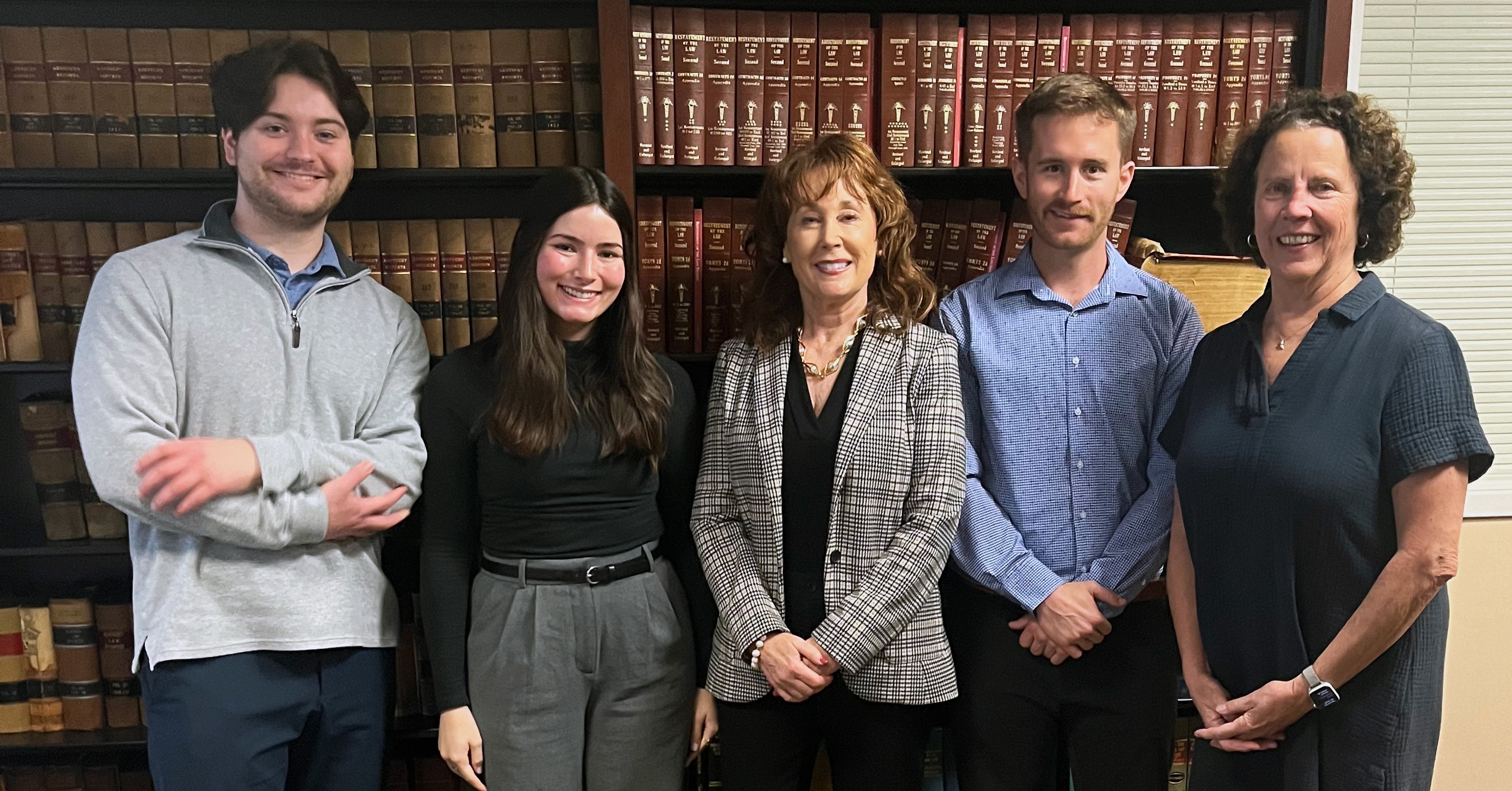
[Above] At the Legal Help Center in Northern Kentucky with Supreme Court of Kentucky Justice Michelle M. Keller, center, and Glenda Harrison, executive director of the Kentucky Access to Justice Commission, right, are then-Chase students and 2025 graduates Charles Bilott, left, and Chloe Lorenzen, and, right, alumnus Aaron Osborne.
While the legal help centers for pro se litigants in Kentucky are a commonwealth-wide program of the Supreme Court of Kentucky, the center in Northern Kentucky has a significant connection to Chase College of Law. The three centers – based in Lexington, Louisville and Covington – are the creation of the Supreme Court’s Access to Justice Commission, chaired by Justice Michelle M. Keller, a Chase alumna, and the Covington center utilizes Chase students from the college’s pro bono program and Chase alumni among its overall lineup of volunteers.
“When interviewed after the opening of our first Legal Help Center in Fayette County [Lexington] in 2022, I stated that the concept of these centers would be a ‘game changer’ for access to justice in the commonwealth,” Justice Keller recalls. “Since that time, we have opened additional help centers in Louisville and Covington. Not only have we provided access to our courts for 5,000 Kentuckians, but we have assisted our judges and clerks, who have often been overwhelmed with the processing of legal matters for so many unrepresented litigants.
“This has been a successful partnership with our local attorneys, judges, clerks, law schools and Kentucky’s four civil legal services organizations.”
Within the Chase connection in Northern Kentucky are alumnus Aaron Osborne and students Logan Voges, Jennifer Holt and others who volunteer through the college’s pro bono program.
“Each visit to the help center is different, and each patron’s needs are different,” says Mr. Osborne, an associate in the firm of O’Hara, Taylor, Sloan, Cassidy, Beck. “You might assist with a straightforward divorce petition one moment and then help someone navigate a complex pro se case the next. Regardless of the issues the patrons face, we’re always able to provide clarity, direction and real help to someone who needs it.”
The experience has been similar for Ms. Voges, who will graduate in 2027: “On the very first day I had to help a few people file for divorce, which involved filling out forms. Each person who comes to the courthouse seeking legal assistance brings a unique experience. I have worked with people who needed help finishing their probate forms, helped on name changes, even child custody agreements.”
For Ms. Holt, who will graduate in 2026, the center has provided something of an on-ramp to a future practice. “Many things I've learned at Chase have applied to this experience. Being able to apply writing skills to actual motions to help clients was very impactful.”
The benefits for center clients and student volunteers are exactly what Justice Keller anticipated.
“As a proud Chase alumna, I want everyone to know that our law students have stepped up to volunteer at the legal help centers in unprecedented numbers. The response from our Chase students has been outstanding, but most importantly, I can confidently say that the experience has been incredibly valuable to these students. They are learning critical skills, such as effective client interviewing, pleading drafting and problem solving.”
Along with in-person assistance, the centers also have guided interviews that allow self-represented litigants to answer a series of questions and create ready-to-file pleadings, says Glenda Harrison, executive director of the Access to Justice Commission and a Chase alumna.
“The most common issues on which patrons at the centers seek assistance are family law, including dissolution of marriage, child custody and child support, expungements, small claims court cases, probate of small estates and, currently, name changes to address Real ID issues. The centers do not provide information on state or federal criminal law matters,” she says.
For clients and student volunteers, the centers provide a lot of help on a variety issues, both immediate or in preparation for future practices.
How to Help
To volunteer at a Legal Help Center, email Glenda Harrison, Kentucky Access to Justice Commission executive director, at glenda.harrison@kyaccesstojusticecommission.org for details or to request a SignUpGenius link for a specific center.
Salmon P. Chase College of Law
Office of Admissions
1 Nunn Drive, 216 Nunn Hall
Highland Heights, KY 41099
859-572-5490