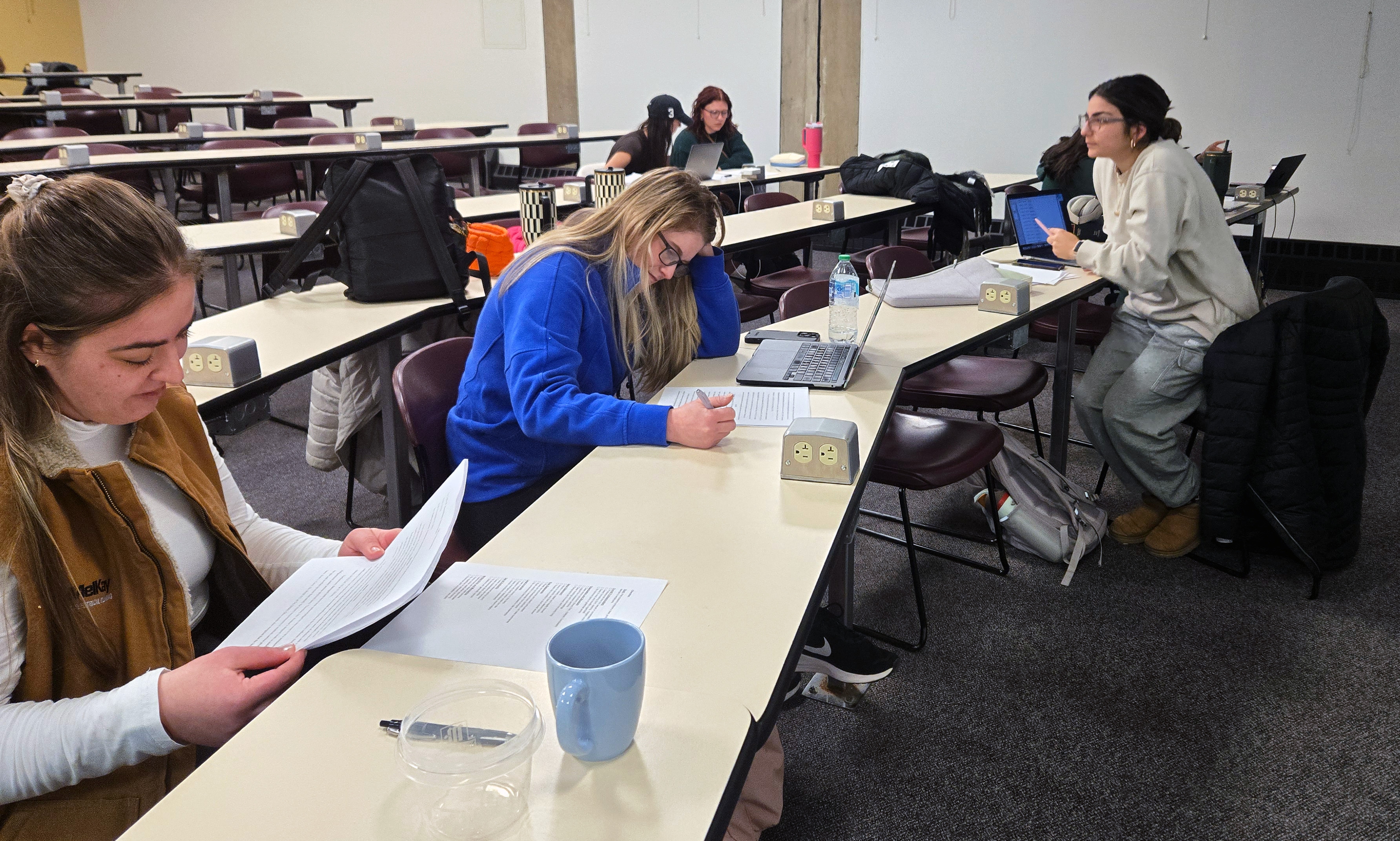
Chase students in the spring
semester legal writing workshop.
As any author knows, a story needs to have a beginning, a middle and an end. It’s called narrative writing. And as any lawyer knows, a memorandum needs to be clear, concise, state a rule, apply it, and reach a conclusion. It’s called legal writing.
For first-year law school students, making the transition from the narrative writing they have been familiar with, as readers and sometime-essayists, to the legal writing now required of them is one of the first chapters in their storylines to becoming lawyers. To help them author it to the end, the Salmon P. Chase College of Law Legal Writing Center offered first-year students at the beginning of spring semester a voluntary workshop to review some of their previous legal writing, with professors and upper-level students.
“Organizing a legal memo is not like organizing other writing,” says Professor Marcia Ziegler, center director. “Some students are fantastic writers, but in vastly different fields. The retraining that law school requires can be tough to understand, so practice is essential. In addition, even the best writers might not know the detail required of a formal legal memo. The process of learning how to synthesize a rule from seemingly disparate cases takes time; seeing how others do so can be very helpful to new legal writers.”
So, at the suggestion of her teaching assistant, student Zu Elkhansa, the center set about to recruit faculty and upper-level student volunteers to sit individually with first-year students to parse some of their initial legal writing and to talk about the process of writing.
“Upper-level student volunteers were recommended by our full-time writing faculty,” Ms. Elkhansa says. “I created checklists so that volunteers clearly understood their roles and expectations, and I coordinated with Kendal Pickens, a 3L and lead articles editor of Chase’s Northern Kentucky Law Review, to encourage law review members to participate. The feedback from our 2Ls and 3Ls was overwhelmingly positive. Many appreciated the opportunity to connect with 1Ls and reflect on their own first-year writing experiences. Several mentioned how rewarding it was to see how much they had grown since 1L year.”
That arc of achievement is how personal storylines develop.
“Tenacity is key to success in law school,” Professor Ziegler points out. “Simply completing the requirements of taking finals and writing memos is rarely enough to excel. When students keep at the hard work of learning the practice, like by rewriting a memo even after it's been turned in, they can forget about the grade on it and really work on fundamentally changing their writing for the better.
“In this workshop, students got an entirely new set of eyes on their memos, helping them practice editing what might already be a successful piece. This practice is incredibly helpful, as lawyers often double- and triple-check their work product, and many students do not come to law school with a great grasp on the technique.”
As for lessons learned: “Many 1Ls shared that it was extremely helpful to speak with 2Ls and 3Ls about what employers look for in writing samples,” Ms. Elkhansa says. “They valued receiving a different perspective on their work, and appreciated hearing firsthand how upper-level students approach selecting and refining their writing samples.”
• You can read more about legal writing at Chase at chaselaw.nku.edu/current-students/legal-writing-program.html.
Salmon P. Chase College of Law
Office of Admissions
1 Nunn Drive, 216 Nunn Hall
Highland Heights, KY 41099
859-572-5490